


Waitrose organic salmon supplier investigated over chemicals in loch
Waitrose organic salmon supplier investigated over chemicals in loch

Sarah KnaptonSat, June 27, 2026 at 6:30 AM UTC
0
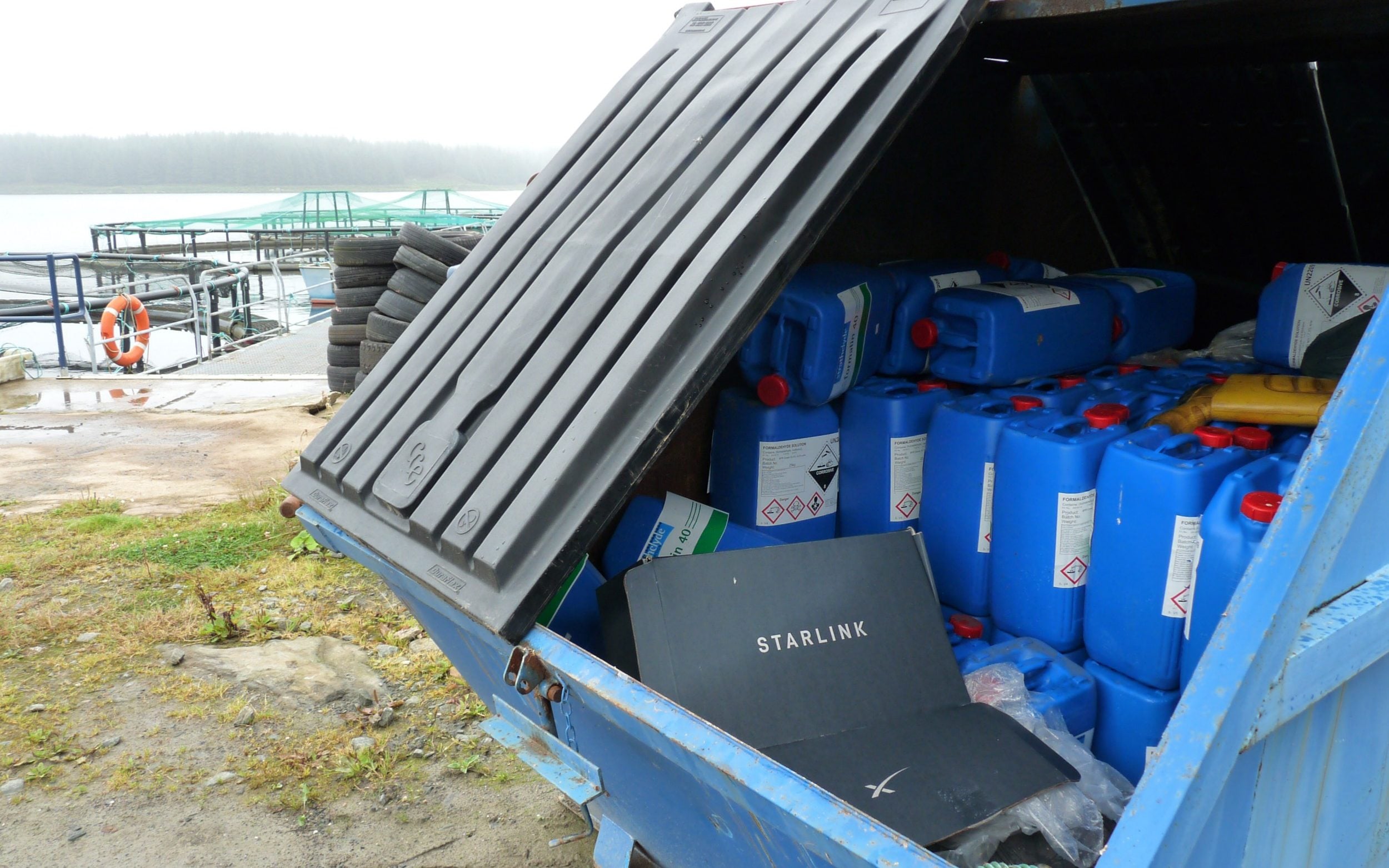
A skip of empty formaldehyde containers at Cooke Aquaculture’s Garasdale site in Kintyre, Argyll
An organic salmon company which supplies Waitrose and M&S is being investigated for pouring formaldehyde into a remote Scottish loch to aid its breeding programme.
In a letter seen by The Telegraph, the Scottish Environment and Protection Agency (SEPA) said it had “acted immediately” and launched an investigation, following complaints from the Green Britain Foundation (GBF) that Cooke Aquaculture used the chemical at its Garasdale site in Kintyre, Argyll.
When GBF investigators visited the site in August 2022 they found a skip full of empty formalin containers – a liquid solution of formaldehyde – and further evidence of the chemical use in 2024.
The Scottish Government’s own Fish Health Inspectorate (FHI) has recorded on at least three occasions the use of formalin at the site to control fungal infections or post-vaccination.
Formalin is a known human carcinogen, with repeated exposure linked to nasal cancers and leukaemia, but it is often used in the fish industry as a disinfectant to control fungal growths, parasites and bacterial diseases.
Organic companies are supposed to limit chemical use and Scottish farms must inform SEPA of any chemicals and medicines they use every three months.
Freedom of information requests to SEPA made by GBF show no record of formaldehyde use at Garasdale.
Dale Vince, the GBF founder, said: “People buy organic salmon believing they’re getting something produced entirely without chemicals.
“That’s the very essence of organic farming and produce – no chemicals, no exceptions.
“So learning that a salmon farm that has organic certification has actually been using formaldehyde, a chemical we know causes cancer, is going to be a shock.”
The GBF believes that no farmed salmon should be called organic because “cramming fish together in cages” causes disease and parasites which can only be solved through chemicals.
Advertisement
The group has also complained to the Soil Association, which certifies organic companies,.
“This isn’t a one-off or rogue event,” said Mr Vince. “The salmon industry won’t even be honest about how much it’s pouring into Scotland’s lochs, or when, or where. Calling farmed salmon organic is a deceit. It must end.”
In March, a freedom of information request to SEPA by Animal Equality UK revealed that formaldehyde use by Scottish salmon farms rose to record levels in 2025, with 48 tons of the chemical released into fresh waters, a rise of 40 per cent from 2024.
The chemical can be dangerous for wild swimmers and fish farm workers, and exposure can cause throat irritation and eye damage as well as triggering asthma attacks. There may also be a more dangerous cumulative effect for those regularly exposed.
Formalin can be toxic to the environment, killing phytoplankton and algae which lowers the amount of oxygen in water, harming marine life.
A spokesman for Cooke Scotland said: “We have not been contacted by the Scottish Environmental Protection Agency regarding an inquiry into the use of formalin at Loch Garasdale. SEPA carried out its latest compliance audit at the site in May 2025, during which all documentation and records were made available. No non-compliance with the site’s permit conditions was identified.
“Formalin is a licensed veterinary medicine used during the freshwater stage of salmon farming to help protect young fish from certain infections.
“Its use is subject to strict veterinary and environmental regulations and is also permitted under the Soil Association’s organic standards where its use meets the relevant requirements. When used in accordance with these requirements, formalin is safe for consumers, fish welfare, farm staff and the environment.”
Cooke Scotland said records of formalin use were “maintained and made available” to SEPA during its audit in 2025.
A spokesman for Waitrose said: “The safety of our products and welfare of the fish couldn’t be more important to us. We require all suppliers to operate in compliance with regulatory and third-party certification.”
M&S was contacted for comment.
Source: “AOL Money”
